Accounting is often seen as the backbone of the I.Com (Intermediate in Commerce) curriculum. It is a subject that rewards logic, practice, and conceptual clarity rather than rote memorization. Yet every year, thousands of students struggle with accounting simply because they are studying from books that are either too complicated, poorly structured, or disconnected from the actual board exam pattern.
If you are an I.Com student, parent, or teacher searching for the best I.Com Accounting book, this guide will help you understand exactly what to look for — and why the right book can be the difference between confusion and confidence.
Also read: I.Com Part 1 Accounting Course: Complete Exam Preparation
Why the Best I.Com Accounting Book Matters for Students
Accounting is not just another subject on your I.Com transcript — it is the foundation for future studies in B.Com, BBA, ACCA, CA, and CMA. Choosing the Best I.Com Accounting Book helps students understand the logical sequence of journal entries, ledgers, trial balances, and final accounts more clearly.
If a student misses even one conceptual link in this chain, the rest of the subject becomes difficult to follow. This is why choosing a book that builds concepts step by step, rather than jumping straight to complex problems, is so important.
Many students develop a fear of accounting not because the subject is genuinely hard, but because their learning material failed to explain the “why” behind the numbers. A good book removes this fear by connecting theory with practical examples.
What Makes an Accounting Book Truly Effective for I.Com Students?
Not all accounting books are created equal. Before choosing one for yourself or your students, check whether it offers the following essential features.
1. Concept-First Approach
The best books don’t start with formulas and problems — they start with concepts. Before solving a journal entry, students should understand what a transaction actually represents in business terms. A strong book explains the logic behind debit and credit, the accounting equation, and the purpose of each financial statement before diving into numerical problems.
2. Alignment with the Latest Board Syllabus
Boards across Pakistan periodically update their curriculum, paper patterns, and marking schemes. A good I.Com accounting book must be fully aligned with the latest syllabus issued by the relevant Board of Intermediate and Secondary Education (BISE). Outdated books can mislead students into studying irrelevant topics while missing important ones.
3. Step-by-Step Solved Examples
Accounting is a practice-based subject. The best books include fully solved examples with clear workings, not just final answers. This allows students to understand the method, not just copy the result. Each step should be labeled and explained so that students can follow the logic independently during revision.
4. Practice Exercises with Varying Difficulty Levels
A quality accounting book doesn’t just give one type of question. It should include:
- Basic practice questions for beginners
- Board-pattern questions similar to past papers
- Challenging problems for advanced practice
This layered approach ensures that both average and high-achieving students benefit from the same book.
5. Past Papers and Guess Papers
Since I.Com exams follow a fairly predictable pattern, a book that includes past board papers, model papers, and chapter-wise important questions gives students a significant advantage. It helps them understand the exact format, marking distribution, and commonly repeated question types.
Also read: I.Com Solved Past Papers
6. Simple, Student-Friendly Language
Accounting terminology can be intimidating for first-time learners. The best books avoid overly technical jargon and instead explain terms like “accrued income,” “depreciation,” or “contra entry” in simple, relatable language with everyday business examples.
Also read: I.Com Accounting Course: Learn Accounting from Basics to Advanced
Key Topics Every I.Com Accounting Book Must Cover
Whether you’re studying under Part I or Part II of the I.Com program, your book should comprehensively cover the following core areas:
- Basic Accounting Concepts – Business transactions, accounting equation, and principles
- Journal and Ledger – Recording and classifying transactions accurately
- Trial Balance – Checking the arithmetical accuracy of accounts
- Subsidiary Books – Cash book, purchase book, sales book, and more
- Bank Reconciliation Statement (BRS) – Matching cash book and bank statement balances
- Depreciation Accounting – Straight-line and reducing balance methods
- Rectification of Errors – Identifying and correcting accounting mistakes
- Final Accounts – Trading account, profit and loss account, and balance sheet
- Partnership Accounting – Admission, retirement, and dissolution of partnerships
- Company Accounts – Basics of share capital and company financial statements
A well-structured book moves through these topics logically, building on previously learned concepts rather than treating each chapter in isolation.
How the Right Book Supports Exam Preparation
Building a Strong Revision Routine
A good accounting book naturally supports revision. Chapter summaries, key formulas, and highlighted definitions allow students to revise quickly before tests without re-reading entire chapters.
Reducing Exam-Day Anxiety
When a student has practiced from a book that mirrors the actual exam format, they walk into the exam hall with familiarity rather than fear. Recognizing question styles and marking patterns significantly reduces anxiety and improves time management during the paper.
Encouraging Self-Assessment
Books that include answer keys and marking guidelines allow students to self-check their practice work. This is particularly useful for self-study students who don’t always have access to a tutor for instant feedback.
Also read: I.Com Past Papers Preparation Course: Practice & Exam Strategies
Tips for Students Using an Accounting Book Effectively
- Don’t skip the theory sections. Many students jump straight to numericals, but understanding the “why” behind each concept makes problem-solving much easier.
- Practice daily, even if briefly. Accounting skills fade quickly without regular practice. Even 20–30 minutes a day keeps concepts fresh.
- Attempt past papers under timed conditions. This builds real exam stamina and highlights weak areas early.
- Maintain a formula and format notebook. Keep a separate page for final account formats, depreciation formulas, and reconciliation steps for quick revision before exams.
- Cross-check your work with solved examples. If your answer doesn’t match, review the steps rather than just the final figure to identify where the error occurred.
Why Choosing a Trusted Publisher Matters
Accounting books published by experienced academic publishers tend to be more reliable because they are developed with input from subject experts, experienced teachers, and updated board guidelines. These publishers regularly revise their content to match syllabus changes and examiner expectations, ensuring students are never studying outdated material.
A trusted publishing house also typically offers:
- Clear printing and diagrams for better readability
- Properly structured chapters with logical flow
- Teacher-reviewed solved exercises
- Updated editions aligned with the current academic year
When selecting your I.Com accounting book, always check the publication year, syllabus alignment, and author credentials before making a purchase.
Also read: Where Can I Buy Books Online in Pakistan
Conclusion
Accounting doesn’t have to be a stressful subject. With the Best I.Com Accounting Book — one that prioritizes concept building, offers board-aligned practice material, and explains topics in simple language — students can approach their exams with greater clarity and confidence.
Whether you’re a first-year I.Com student just starting with journal entries or a second-year student preparing for final accounts and partnership topics, choosing the Best I.Com Accounting Book can make your preparation more structured, effective, and exam-focused.
Choose wisely, practice consistently, and let the Best I.Com Accounting Book become a true study partner — not just another textbook on your shelf.
Build stronger accounting concepts with the right study material.
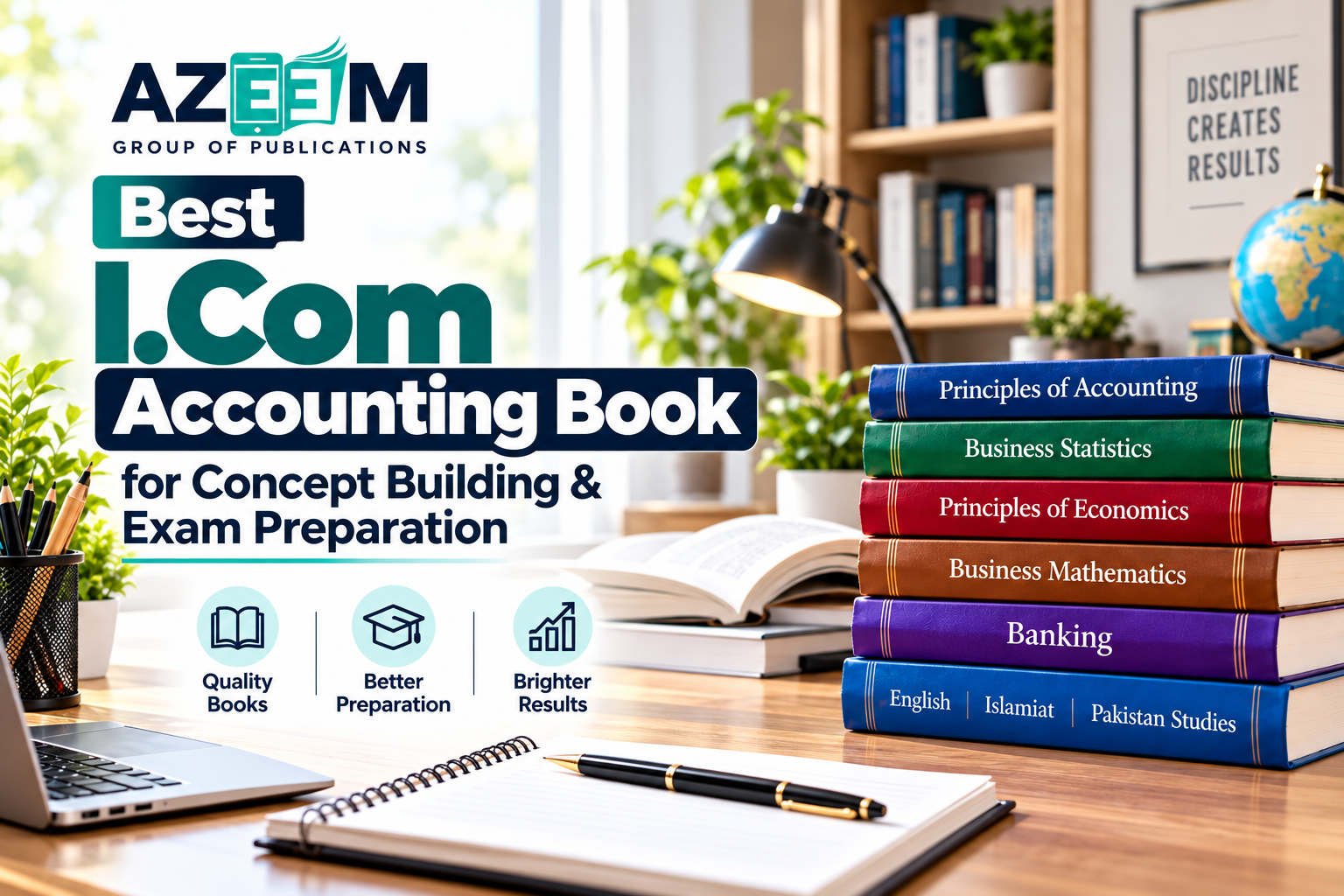
Explore reliable I.Com Accounting books from Azeem Groups designed to support concept building, practice, and exam preparation.