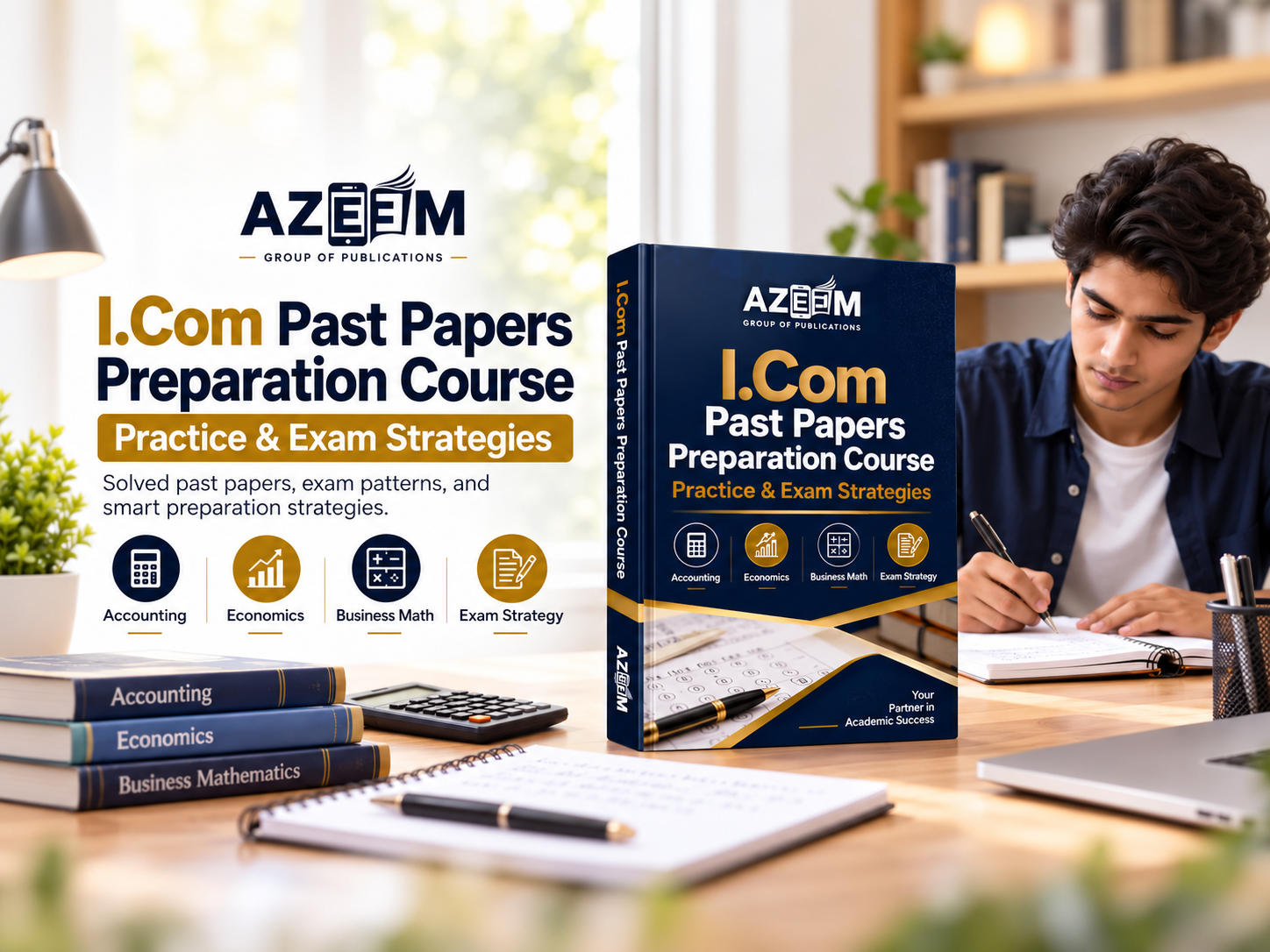
Every year, thousands of commerce students across Pakistan sit for their I.Com examinations, hoping to secure top marks and open doors to admission in the best colleges and universities. Yet, despite hours of studying, many students struggle to translate their knowledge into strong exam results. The missing link is often not a lack of understanding, but a lack of structured practice using I.Com past papers.
This is where a well-designed I.Com Past Papers Preparation Course becomes a game-changer. By combining subject revision with real exam-pattern practice, students can walk into their examination halls with confidence, speed, and a clear strategy. In this article, we’ll explore why past papers matter, how to use them effectively, and the exam strategies that consistently help I.Com students score higher.
Also read: I.Com Part 1 Past Papers Course: Prepare with Solved Exam Questions
Why I.Com Past Papers Matter So Much
Past papers are not just old question sheets—they are a roadmap to the examiner’s mind. Boards across Pakistan, whether BISE Lahore, BISE Karachi, or any other regional board, tend to follow recurring patterns in question types, marking schemes, and topic weightage.
They Reveal Exam Patterns
By solving five to ten years of past papers, students quickly notice which topics from Principles of Accounting, Business Mathematics, Economics, and Commerce appear most frequently. This helps in prioritizing study time on high-yield chapters instead of spreading effort evenly across the entire syllabus.
They Build Time Management Skills
One of the biggest challenges I.Com students face is completing their paper within the allotted time. Practicing past papers under timed conditions trains the brain to work faster on numerical problems and structure written answers more efficiently.
They Reduce Exam Anxiety
Familiarity breeds confidence. When a student has already solved dozens of similar questions before the actual exam, the fear of the unknown disappears. This alone can significantly reduce exam-day stress and improve performance.
Students can also review official old question papers and model papers provided by the Federal Board of Intermediate and Secondary Education (FBISE) to better understand exam patterns and question formats.
What a Good I.Com Preparation Course Should Include
Not all preparation resources are created equal. A genuinely useful I.Com past papers preparation course should go beyond simply reprinting old papers. Here’s what makes a course truly effective.
Subject-Wise Compilation
A quality course organizes past papers by subject—Accounting, Economics, Commerce, Statistics, and Business Mathematics—rather than dumping everything together. This allows students to focus on one subject at a time and track their improvement clearly.
Solved Answers with Explanations
Simply having questions isn’t enough. Students need model answers and step-by-step solutions, especially for numerical subjects like accounting and statistics, where the method matters as much as the final answer.
Chapter-to-Paper Mapping
The best courses map each past paper question back to its relevant textbook chapter. This helps students revise the concept first and then immediately apply it through practice, reinforcing learning far more effectively than passive reading.
Marking Scheme Insights
Understanding how examiners allocate marks is crucial. A good preparation course explains where marks are given—for correct formulas, proper formatting, workings shown, or relevant examples—so students don’t lose easy marks due to presentation mistakes.
Also read: I.Com Subjects Course: Complete Preparation for All Major Subjects
Effective Study Strategies Using Past Papers
Having the right resources is only half the battle. Students also need a strategic approach to using past papers for maximum benefit.
Start with Topic-Wise Practice
Before attempting a full past paper, students should first practice questions topic by topic. For example, solve all past questions on “Depreciation” from Accounting before moving to “Partnership Accounts.” This builds mastery in smaller, manageable chunks.
Move to Timed Full-Length Papers
Once individual topics feel comfortable, students should attempt complete past papers under exam-like time constraints. This simulates real exam pressure and highlights any remaining weak areas.
Analyze Mistakes Honestly
After each practice paper, students must go through their mistakes carefully. Ask: Was it a conceptual gap, a calculation error, or a time-management issue? Each type of mistake requires a different fix.
Repeat the Toughest Papers
Some past papers are naturally harder than others. Rather than avoiding these, students should revisit them multiple times until they can solve them confidently and within time limits.
When choosing I.Com preparation resources, students should make sure the material matches the latest curriculum requirements and follows current academic guidelines issued by recognized education authorities in Pakistan.
For updated curriculum information, students can refer to the official curriculum resources provided by the Higher Education Commission of Pakistan.
Subject-Specific Exam Strategies for I.Com Students
Different I.Com subjects demand different approaches. A well-planned I.Com Past Papers Preparation Course helps students understand how to prepare for each subject according to its exam pattern and question style. Here’s how to tackle the major ones strategically.
Principles of Accounting
Accounting is largely practice-based. Students should focus on journal entries, ledger posting, trial balance, and final accounts, as these appear in nearly every past paper. Neat presentation and correct formats earn extra marks, so practicing with proper headings and columns is essential. An I.Com Past Papers Preparation Course can also help students identify frequently repeated accounting questions and improve accuracy through regular practice.
Business Mathematics and Statistics
These subjects reward speed and accuracy. Students should memorize key formulas and practice mental shortcuts for calculations. Past papers reveal which formula-based questions repeat most often, allowing targeted formula memorization and more efficient exam preparation.
Economics
Economics often involves both theory and diagram-based questions. Students should practice drawing clean, labeled diagrams quickly, as these are frequently worth significant marks. Past papers help identify the most commonly asked theoretical concepts and allow students to focus on high-priority topics.
Commerce
Commerce past papers often repeat definitions and short-answer questions. Students benefit from creating concise, memorable summaries of key terms and processes, such as types of business organizations or functions of management. Regular practice through an I.Com Past Papers Preparation Course can make revision more structured and help students become familiar with commonly repeated question formats.
Also read: What Are the Subjects of I.Com? A Complete Guide for Students in Pakistan
How Publishers Can Support I.Com Students Better
As an academic publishing house, there is a valuable opportunity to support students beyond just printing textbooks. A dedicated I.Com Past Papers Preparation Course—whether in book form, workbook style, or supplementary guide—can include:
- Compiled past papers from the last 8–10 years across major boards
- Fully solved solutions with step-by-step explanations
- Chapter-wise question banks linked to the syllabus
- Model answer sheets showing ideal presentation and marking allocation
- Quick-revision formula sheets for numerical subjects
By packaging these elements together, publishers don’t just sell a book—they provide a genuine study companion that addresses the real needs of I.Com students preparing for board exams.
Tips for Choosing the Right Past Papers Book
With so many guides available in the market, students and parents should look for a few key qualities when selecting an I.Com past papers preparation book:
- Board-specific coverage – Ensure the papers match the student’s specific board (Lahore, Karachi, Federal, etc.)
- Updated syllabus alignment – Papers should reflect the current curriculum, not outdated content
- Clarity of solutions – Answers should be easy to follow, not just correct
- Practice space – Some editions include blank spaces for students to attempt questions directly in the book
- Author credibility – Books authored or reviewed by experienced I.Com teachers tend to be more reliable
Must read: I.Com Solved Past Papers
Conclusion
Success in I.Com examinations isn’t just about knowing the syllabus—it’s about knowing how to apply that knowledge under exam conditions. A structured I.Com Past Papers Preparation Course bridges this gap by combining focused practice, proven exam strategies, and deep familiarity with board patterns.
For students, the message is clear: don’t just study—practice smart. Work through past papers systematically, analyze mistakes, and refine your approach subject by subject. A well-structured I.Com Past Papers Preparation Course can make this process easier by giving students a clear practice plan and helping them understand real exam patterns. For publishers and educators, there is a real opportunity to create resources that go beyond textbooks and genuinely prepare students for exam-day success.
With the right I.Com Past Papers Preparation Course, a useful past papers guide, and a disciplined practice routine, I.Com students can transform exam anxiety into exam confidence—and turn hard work into the results they truly deserve.
Score better with smarter I.Com exam preparation. Shop Now for trusted study resources, or Contact Azeem Groups for guidance.