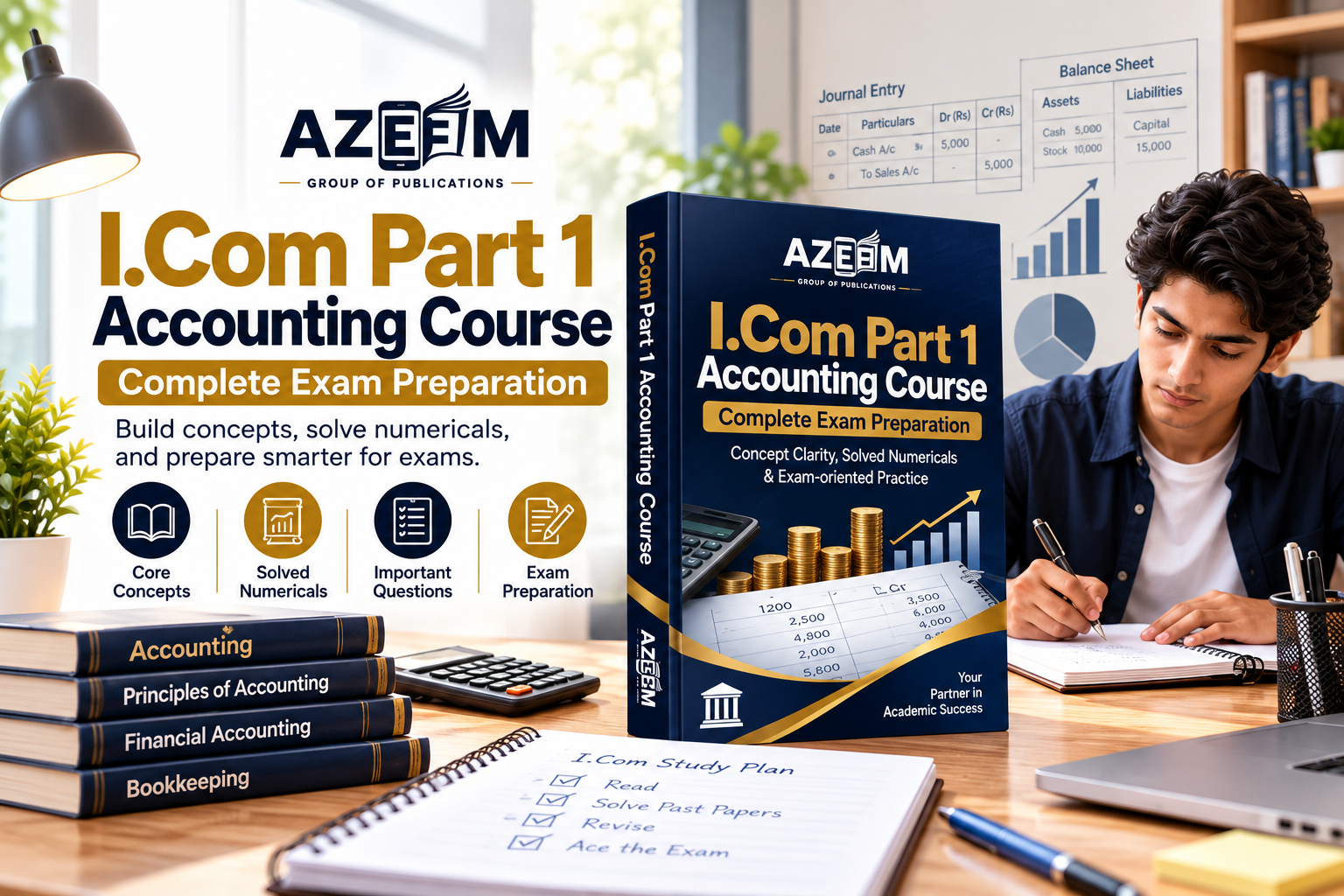
Accounting is one of the most important subjects in the Intermediate in Commerce program. For students who want to build a strong foundation in business, finance, banking, and professional accounting, the I.Com Part 1 Accounting Course plays a major role. It introduces students to the basic principles of accounting and gradually develops their ability to record, organize, analyze, and present financial information.
Many students find accounting difficult at first because the subject involves concepts, calculations, formats, and regular practice. However, once the basic rules of debit and credit become clear, the subject becomes much easier to understand.
This complete guide to the I.Com Part 1 Accounting Course will help students understand the syllabus, important topics, preparation strategies, common mistakes, study resources, and exam techniques needed for better board exam performance.
Students can also explore I.com and accounting-related courses offered by Allama Iqbal Open University(AIOU)
Understanding the I.Com Part 1 Accounting Course
The I.Com Part 1 Accounting Course is designed to introduce students to the fundamentals of financial accounting. It teaches how business transactions are recorded and how those records are later used to prepare financial statements.
Students begin with basic accounting concepts and gradually move toward more detailed topics such as journals, ledgers, trial balances, bank reconciliation, depreciation, and final accounts.
A strong understanding of these topics is important because most accounting chapters are connected. If a student does not understand journal entries properly, it becomes difficult to prepare ledgers, trial balances, and final accounts accurately.
Also read: I.Com Accounting Course: Learn Accounting from Basics to Advanced
Why the I.Com Part 1 Accounting Course Is Important
The course is not only useful for passing board exams. It also creates a foundation for future studies in commerce and business.
Students who understand accounting at the I.Com level are better prepared for programs such as B.Com, BBA, ACCA, CA, ICMA, and other business-related qualifications.
Accounting also develops practical skills such as:
- Financial record keeping
- Analytical thinking
- Problem solving
- Business decision-making
- Understanding profit and loss
- Managing assets and liabilities
These skills are useful for students who plan to work in banking, business management, finance, auditing, or entrepreneurship.
Students can also explore: https://icap.org.pk/
I.Com Part 1 Accounting Course Syllabus
The exact syllabus may vary depending on the education board, but the I.Com Part 1 Accounting Course generally includes the core topics students need to understand basic financial accounting.
Introduction to Accounting
Students first learn the meaning, objectives, and importance of accounting. This section usually covers basic terms such as assets, liabilities, capital, revenue, expenses, drawings, and business transactions.
Understanding the Accounting Equation
One of the most important concepts is the accounting equation:
Assets = Liabilities + Capital
Students should understand how different business transactions affect this equation. This concept creates the foundation for understanding the double-entry system.
Journal Entries
Journal entries are one of the most important parts of the I.Com Part 1 Accounting Course.
Students learn how to identify which account should be debited and which account should be credited for each transaction.
Regular practice is essential because journal entries are used throughout the accounting process.
Common transactions include:
- Cash purchases
- Credit purchases
- Cash sales
- Credit sales
- Expenses
- Drawings
- Capital introduced
- Payments to creditors
- Receipts from debtors
Ledger Accounts
After recording transactions in the journal, students learn how to transfer them into ledger accounts.
The ledger helps organize transactions under separate account headings. A clear understanding of journal entries makes ledger posting much easier.
Students should practice correct formats and balancing procedures because presentation is also important in accounting exams.
Trial Balance
A trial balance is prepared to check the arithmetical accuracy of ledger accounts.
Students learn how to place debit and credit balances correctly and calculate totals on both sides.
If both sides are equal, it usually indicates that the accounts have been recorded mathematically correctly, although some accounting errors may still remain.
Must Read: I.Com Subjects Course: Complete Preparation for All Major Subjects
Important Topics in the I.Com Part 1 Accounting Course
Some topics require extra attention because students often find them challenging or because they involve multiple steps.
Bank Reconciliation Statement
The Bank Reconciliation Statement, commonly known as BRS, compares the balance shown in the cash book with the balance shown in the bank statement.
Differences may occur because of:
- Cheques issued but not yet presented
- Cheques deposited but not yet cleared
- Bank charges
- Direct deposits
- Standing orders
- Errors in records
Students should practice BRS questions regularly because understanding the reason behind each adjustment is more useful than memorizing rules.
Rectification of Errors
Accounting errors may occur while recording or posting transactions.
The I.Com Part 1 Accounting Course teaches students how to identify and correct different types of errors.
Understanding rectification is important because mistakes in earlier accounting records can affect later statements.
Depreciation
Depreciation refers to the reduction in the value of a fixed asset over time.
Students usually learn different methods of calculating depreciation, including the straight-line method and written-down value method.
How to Prepare Depreciation Questions
Instead of memorizing formulas only, students should understand:
- Why depreciation is charged
- Which assets are depreciated
- How depreciation affects profit
- How depreciation affects asset values
- How different methods produce different results
Conceptual understanding makes numerical questions much easier.
Final Accounts
Final accounts are among the most important topics in the I.Com Part 1 Accounting Course.
Students may be required to prepare:
- Trading Account
- Profit and Loss Account
- Balance Sheet
Final account questions often include adjustments, so students need to practice carefully.
Common Final Account Adjustments
Students should pay special attention to:
- Outstanding expenses
- Prepaid expenses
- Accrued income
- Depreciation
- Bad debts
- Closing stock
These adjustments can affect more than one part of the final accounts, so students should understand where and why each adjustment is recorded.
Also read: I.Com Part 1 Past Papers Course: Prepare with Solved Exam Questions
Common Problems Students Face in Accounting
Many students struggle with accounting because of their study method rather than the subject itself.
Weak Understanding of Debit and Credit Rules
Students often try to memorize entries without understanding the logic behind them.
This becomes a problem when exam questions are different from textbook examples.
The better approach is to understand the type of account involved and how the transaction changes that account.
Lack of Daily Practice
Accounting is a practical subject. Reading a chapter without solving questions is usually not enough.
Even 30 to 45 minutes of daily practice can significantly improve speed and accuracy.
Ignoring Theory Questions
Some students focus only on numerical questions, but board exams may also include definitions, concepts, principles, and short theoretical questions.
Theory should be revised alongside numerical practice.
Studying Only Before the Exam
The I.Com Part 1 Accounting Course contains connected topics. Last-minute preparation can make it difficult to understand the sequence properly.
Consistent preparation is usually much more effective.
How to Prepare for the I.Com Part 1 Accounting Course
A structured study plan can make accounting much easier.
Start With Basic Accounting Concepts
Before solving difficult questions, students should make sure they understand basic terms such as assets, liabilities, capital, income, expenses, debtors, and creditors.
These concepts appear throughout the course.
Practice Journal Entries Every Day
Journal entries should become almost automatic.
Students can improve by solving different types of transactions instead of repeating only easy questions.
Move From Journal to Ledger and Trial Balance
Once journal entries are clear, students should practice the complete accounting cycle.
This means recording transactions in the journal, posting them to the ledger, balancing accounts, and preparing the trial balance.
This approach helps students understand how different chapters connect.
Give Extra Time to Final Accounts
Final accounts are often considered one of the most important areas of accounting preparation.
Students should practice complete questions and pay special attention to adjustments.
Practice Past Papers
Past papers are extremely useful for understanding:
- Question patterns
- Commonly tested topics
- Paper structure
- Time management
- Required answer presentation
Students should solve past papers under timed conditions before the final exam.
Also read: I.Com Accounting Course: Learn Accounting from Basics to Advanced
Best Study Material for the I.Com Part 1 Accounting Course
Good study material can make exam preparation much easier.
Students should choose books and guides that are simple, updated, and aligned with their board syllabus.
What a Good Accounting Book Should Include
A useful accounting book should provide:
- Clear explanations
- Solved examples
- Practice questions
- Chapter-wise exercise
- Short questions
- Long questions
- Numerical problems
- Past paper practice
- Model papers
- Easy-to-understand formats
A well-structured guide helps students understand not only the answer but also the method used to reach it.
I.Com Part 1 Accounting Course Exam Preparation Tips
Students can improve their exam performance by combining subject knowledge with a good exam strategy.
Use Proper Formats
Accounting answers should be neat and organized.
Students should use proper headings and formats for:
- Journal entries
- Ledger accounts
- Trial balance
- Bank reconciliation statements
- Final accounts
Correct presentation makes answers easier to understand and can reduce mistakes.
Show Complete Working
Do not skip important calculations.
Showing working helps demonstrate the method and may help students secure marks even if the final figure contains a small error.
Manage Exam Time Carefully
Students should divide their time according to the marks of each question.
Spending too much time on one question can create problems later in the paper.
Attempt Easier Questions First
Starting with questions you understand well can build confidence and help save time.
Students should then move to longer or more difficult numerical problems.
Also read: I.Com Past Papers Preparation Course: Practice & Exam Strategies
Final Weeks Before the Accounting Exam
The last few weeks should focus mainly on revision and practice.
Students should avoid trying to learn too many completely new topics at the last moment.
Create a Revision Checklist
Prepare a checklist containing all major chapters of the I.Com Part 1 Accounting Course and mark each topic after revision.
This helps ensure that no important chapter is missed.
Solve Full-Length Papers
Students should solve several complete board or model papers under exam conditions.
After completing each paper, review mistakes carefully and revise the related topic.
Revise Important Rules and Formats
Before the exam, students should repeatedly review:
- Debit and credit rules
- Accounting equation
- BRS adjustments
- Depreciation formulas
- Trial balance format
- Final account adjustments
Quick revision notes can be very useful during the final days.
Conclusion
The I.Com Part 1 Accounting Course provides students with a strong foundation in financial accounting and prepares them for future studies in commerce, finance, and business. Although the subject may initially appear difficult, it becomes much easier when students understand the basic concepts and practice regularly.
Success in accounting does not come from memorizing answers. Students need to understand the logic behind transactions, debit and credit rules, ledger posting, trial balances, depreciation, bank reconciliation, and final accounts.
With a structured study schedule, regular numerical practice, reliable study material, and consistent past paper preparation, students can approach the I.Com Part 1 Accounting Course with greater confidence.
The most important strategy is to start early, practice consistently, revise important concepts regularly, and correct mistakes as soon as they appear. With the right preparation, students can strengthen their accounting knowledge and improve their chances of achieving excellent marks in their board examinations.
Start Your Study Journey Today
Browse the Azeem Groups Shop for academic books, or Contact Us to find the right book for you.