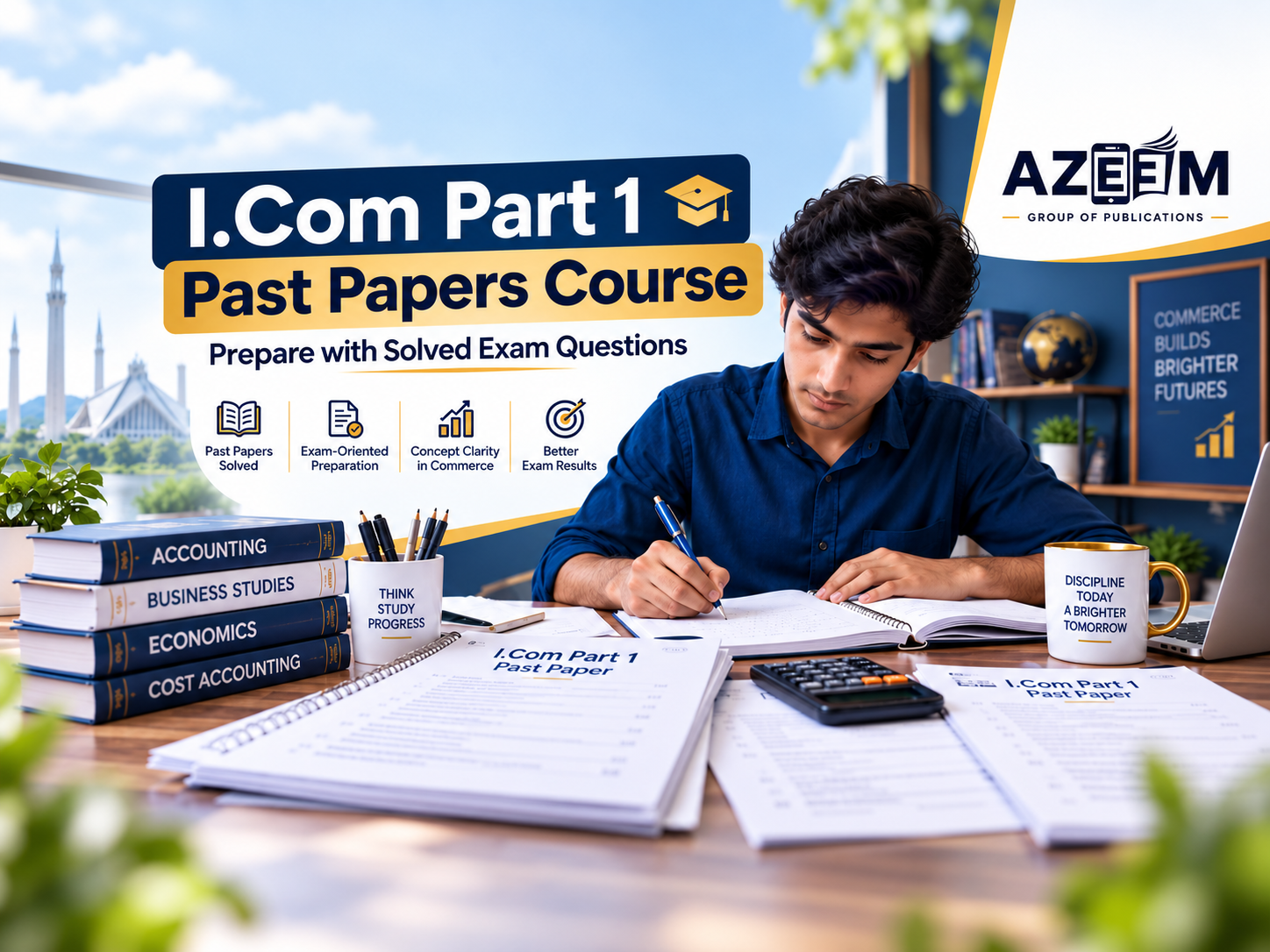
Every year, thousands of students across Pakistan enroll in I.Com Part 1 hoping to build a strong foundation in commerce, accounting, and business studies. Yet when exams approach, many students feel overwhelmed, unsure of what to study, and anxious about the format of the paper. The good news is that there’s a proven way to eliminate this uncertainty: studying with a dedicated I.Com Part 1 Past Papers Course built around solved exam questions.
This article explains why past papers matter, how a structured solved-questions course can transform your exam preparation, and how to use one effectively to score higher marks in your board exams.
Also read: 1st Year ICOM Books Name: Complete List and Guide for Commerce Students
Why I.Com Part 1 Is a Critical Academic Year
I.Com Part 1 is the first step toward a career in commerce, finance, banking, or business administration. Subjects like Principles of Accounting, Business Mathematics, Economics, Commerce, and Statistics introduce concepts that form the backbone of higher studies in B.Com, BBA, and professional certifications like ACCA or CA.
Because these subjects are foundational, board examiners often repeat similar question patterns year after year. This is precisely why past papers become one of the most powerful tools available to students preparing for their annual exams.
Students planning to continue their studies in commerce can also explore the official Commerce curriculum resources provided by the Higher Education Commission of Pakistan to understand how commerce education progresses at higher levels.
What Is an I.Com Part 1 Past Papers Course?
An I.Com Part 1 Past Papers Course is a structured study resource that compiles previous years’ board exam papers along with detailed, step-by-step solved answers. Unlike scattered notes or random guess papers found online, a proper course organizes past papers by:
- Subject (Accounting, Economics, Commerce, Statistics, Business Math)
- Year-wise board papers from major boards across Pakistan
- Chapter-wise categorization so students can identify frequently tested topics
- Fully solved answers explaining the correct method, not just the final result
This structure allows students to study smarter, not just harder, by focusing on what actually appears in exams.
Key Features to Look For
A high-quality past papers course should include:
- Solved theoretical questions with model answers matching board marking schemes
- Numerical problems solved step-by-step, especially for Accounting and Business Math
- MCQs with explanations, not just answer keys
- Important question highlights based on repetition analysis across past years
- Board-wise coverage, since papers can vary slightly between Punjab, Sindh, KPK, and Federal boards
Also read: I.Com Solved Past Papers
Benefits of Studying with Solved Exam Questions
1. Understand the Exact Exam Pattern
Board exams follow a consistent structure year after year. By reviewing past papers, students immediately understand how many questions to expect, how marks are distributed, and which chapters carry the most weight. This removes guesswork and helps students plan their preparation time efficiently.
Students can also review the official old question papers and model papers provided by FBISE to better understand paper structure, question formats, and examination patterns.
2. Identify Repeated and Important Questions
One of the biggest advantages of past papers is spotting repeated questions. Many board papers reuse similar numerical problems, definitions, and short questions across multiple years. A dedicated course highlights these patterns, allowing students to prioritize high-yield topics instead of studying the entire syllabus with equal intensity.
3. Learn the Correct Answering Technique
It’s not enough to know the right answer — students need to present it the way examiners expect. Solved past papers demonstrate the ideal length, format, and structure for theory answers, as well as the correct step-by-step method for solving accounting entries or mathematical problems. This directly impacts how many marks a student secures, even when the concept is understood.
4. Build Exam-Day Confidence
Practicing with real board questions under timed conditions simulates the actual exam environment. This reduces anxiety, improves time management, and helps students walk into the exam hall feeling prepared rather than overwhelmed.
5. Strengthen Weak Areas Early
Working through past papers reveals which topics a student struggles with well before the final exam. This gives enough time to revisit difficult chapters, seek help from teachers, or use additional practice material — rather than discovering gaps in knowledge the night before the exam.
How to Use an I.Com Part 1 Past Papers Course Effectively
Simply owning a past papers course isn’t enough — how you use it determines your results. Here’s a practical approach:
Step 1: Start with Chapter-Wise Practice
Before attempting full past papers, go through solved questions chapter by chapter. This reinforces classroom learning and builds a solid base before moving to timed practice.
Step 2: Attempt Full Papers Under Timed Conditions
Once comfortable with individual chapters, attempt complete past papers within the actual exam time limit (usually 2.5 to 3 hours). This trains you to manage time across long and short questions.
Step 3: Compare Your Answers with Model Solutions
After attempting a paper, compare your answers with the solved solutions provided in the course. Pay close attention to:
- Missing steps in numerical problems
- Incomplete theory answers
- Formatting errors in accounting statements
Step 4: Track Recurring Question Patterns
Keep a list of questions or topics that appear frequently across different years. These deserve extra revision time, as they are statistically more likely to reappear.
Step 5: Revise MCQs Regularly
MCQs often carry easy marks but are frequently underestimated. Regular revision of solved MCQs from past papers ensures you don’t lose easy points due to unfamiliarity with objective-type questions.
Also read: I.Com Solved Past Papers
Subject-Wise Preparation Tips Using Past Papers
Principles of Accounting
Focus on solved numerical questions covering journal entries, ledger accounts, trial balance, and financial statements. Accuracy and proper formatting matter more than speed at this stage.
Business Mathematics
Practice solved equations, ratios, and commercial arithmetic problems repeatedly. Past papers reveal which formulas are tested most often.
Economics and Commerce
These subjects rely heavily on theory. Reviewing solved past paper answers helps students learn how to write concise, well-structured responses that meet examiner expectations within word limits.
Statistics
Pay attention to solved problems on averages, dispersion, and probability, as these topics are consistently tested across boards.
Explore Now: Principles of Accounting, Business Mathematics, Principle of Commerce, Principle of Economics
Why Choose a Published, Structured Course Over Random Online Notes
While the internet offers countless free resources, much of it is unverified, inconsistent, or poorly explained. A professionally published I.Com Part 1 Past Papers Course offers:
- Accuracy aligned with official board marking schemes
- Consistency in formatting and explanation style
- Comprehensive coverage of multiple years and boards
- Reliability, since content is reviewed by subject experts and experienced educators
For students who want dependable results rather than fragmented information, a properly compiled course from a trusted academic publisher makes preparation significantly more efficient.
Conclusion
Success in I.Com Part 1 exams isn’t just about how much you study — it’s about how strategically you prepare. A well-structured I.Com Part 1 Past Papers Course with solved exam questions gives students a clear roadmap: understanding exam patterns, mastering repeated questions, learning correct answering techniques, and building genuine exam-day confidence.
Rather than relying on guesswork or incomplete online notes, invest in a reliable, expert-verified past papers course. It’s one of the most effective ways to turn exam anxiety into exam readiness — and set yourself up for strong results in I.Com Part 1.
Boost your I.Com Part 1 exam preparation with trusted study resources from Azeem Groups. Shop now or contact us for the right exam preparation material.