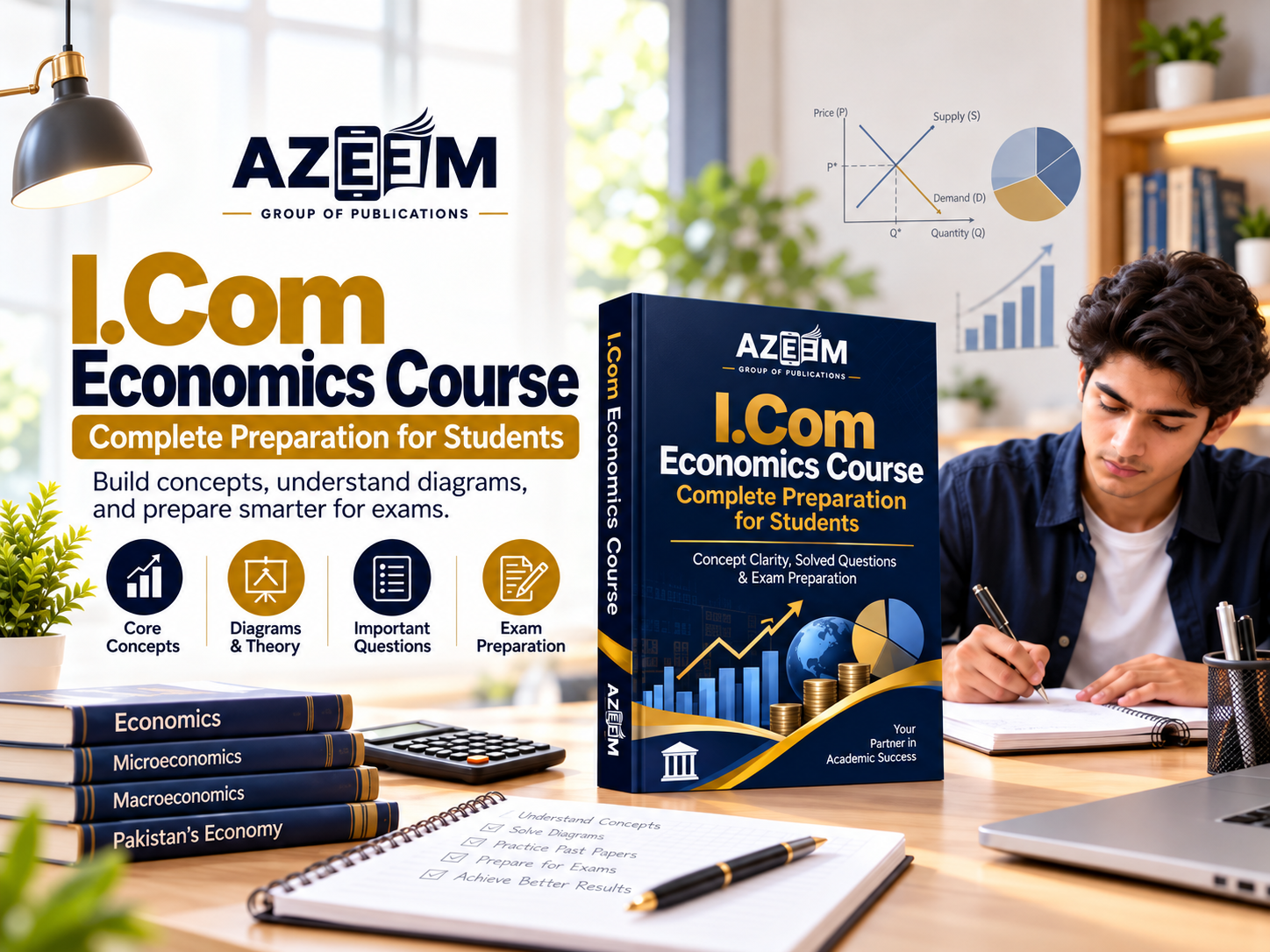
If you are an I.Com student searching for a reliable way to prepare for your Economics exams, this I.Com Economics Course guide will walk you through everything you need to know — from the course structure and important topics to preparation strategies and the best study resources available in Pakistan.
What is I.Com Economics Course?
Students can also explore basic Microeconomics and Macroeconomics, concept through OpenStax’s Principals of Economics:
The I.Com Economics Course is a core subject taught in Part I and Part II of the Intermediate in Commerce program. It introduces students to the fundamental principles of microeconomics and macroeconomics, helping them understand how individuals, businesses, and governments make decisions regarding the allocation of scarce resources.
Students can also explore Microeconomics and Macroeconomics topic through Khan Acadmeny’s: https://www.khanacademy.org/economics-finance-domain
The I.Com Economics Course is also designed to develop analytical thinking and prepare students for advanced studies in B.Com, BBA, and professional accounting programs such as ACCA and ICMA.
The I.Com Economics Course helps students understand key economic concepts such as demand and supply, inflation, market behavior, national income, and Pakistan’s economy. By studying the I.Com Economics Course with the right syllabus, notes, past papers, and exam preparation strategy, students can improve their conceptual understanding, prepare effectively for board exams, and build a strong foundation for higher studies in commerce, finance, business, and economics.
Also read: I.Com Subjects Course: Complete Preparation for All Major Subjects
Why Economics Matters for Commerce Students
Economics is not just a theoretical subject — it has real-world applications that commerce students will use throughout their professional lives. Understanding economic principles helps students:
- Analyze market behavior and pricing mechanisms
- Understand national income, inflation, and unemployment
- Make informed business and financial decisions
- Build a strong base for higher studies in finance and economics
Students can also review the official Intermediate study scheme and Economics syllabus provided by the Board of Intermediate and Secondary Education Lahore to better understand important topics, course requirements, and exam preparation guidelines. https://www.biselahore.com/
I.Com Economics Course Outline
The I.Com Economics syllabus is divided into two parts, each covering distinct areas of study. Understanding the outline helps students plan their preparation more effectively.
Part I: Introduction to Economics
In the first year, students are introduced to the basic concepts of economics, including:
- Definition and scope of Economics
- Basic economic problems – scarcity, choice, and opportunity cost
- Demand and Supply – law of demand, law of supply, and market equilibrium
- Elasticity of demand and supply
- Theory of consumer behavior
- Forms of market – perfect competition, monopoly, and oligopoly
Part II: Macroeconomics and Pakistan’s Economy
The second year focuses on macroeconomic concepts and the economic issues specific to Pakistan, such as:
- National income accounting
- Money, banking, and inflation
- Public finance and taxation
- International trade and balance of payments
- Economic problems of Pakistan – poverty, unemployment, and underdevelopment
- Economic planning and development strategies
This structured approach ensures that students gradually build their understanding, moving from basic definitions to complex national and global economic issues.
Common Challenges I.Com Economics
Many students struggle with Economics not because the subject is inherently difficult, but because of how they approach it. Some common challenges include:
1. Confusing Theoretical Concepts
Terms like elasticity, equilibrium, and opportunity cost can seem abstract without proper real-life examples and diagrams.
2. Numerical and Graphical Problems
Economics involves calculations and graph-based questions (such as demand-supply curves), which require regular practice.
3. Lengthy Definitions and Explanations
Board exams often ask for detailed definitions and explanations, and students frequently lose marks due to incomplete or poorly structured answers.
4. Lack of Updated Study Material
Outdated books or unclear notes can make it difficult for students to align their preparation with the current board syllabus.
Also Read: 1st Year ICOM Books Name: Complete List and Guide for Commerce Students
How to Prepare for I.Com Economics Effectively
Success in I.Com Economics requires a mix of conceptual clarity, consistent practice, and smart exam strategy. Here’s a complete preparation plan for students.
Step 1: Understand the Syllabus Thoroughly
Before diving into detailed study, review the complete syllabus and past board papers. This helps you identify important topics and recurring question patterns.
Step 2: Build Strong Conceptual Foundations
Focus on understanding core concepts rather than memorizing them. For example, instead of just learning the definition of “elasticity of demand,” understand how and why it changes with price fluctuations.
Step 3: Practice Diagrams and Numerical Questions
Economics diagrams — such as demand and supply curves — are frequently tested. Practice drawing them accurately and labeling all components correctly. Similarly, solve numerical problems related to elasticity and national income regularly.
Step 4: Use Reliable Textbooks and Guidebooks
Choosing the right study material makes a significant difference. Look for books that:
- Follow the latest board syllabus
- Include solved past papers
- Provide short and long question practice
- Explain concepts with relevant Pakistani examples
Step 5: Practice Past Papers and Model Papers
Solving previous years’ board papers helps students understand the exam pattern, marking scheme, and frequently asked questions. It also improves time management during the actual exam.
Step 6: Revise Regularly
Economics requires consistent revision, especially for definitions, formulas, and diagrams. Create short notes for quick revision before exams.
Best Study Resources for I.Com Economics
Choosing the right academic resources can save time and improve exam performance. When selecting a book or guide, consider the following:
Look for Board-Aligned Content
Ensure the book follows the syllabus prescribed by your respective Board of Intermediate and Secondary Education (BISE).
Solved Exercises and Past Papers
A good economics guidebook should include solved exercises, chapter-wise questions, and previous board papers with model answers.
Clear Diagrams and Illustrations
Since Economics involves several graphical concepts, a book with clear, labeled diagrams makes learning much easier.
Simple Language and Examples
Books that explain concepts in simple language with real-life examples from Pakistan’s economy help students grasp difficult topics faster.
Many students rely on well-structured I.Com Economics guidebooks published by trusted academic publishers, as these resources are specifically designed according to board requirements and exam patterns.
Tips for Scoring High Marks in I.Com Economics
Here are some practical tips to help you maximize your marks in the Economics exam:
- Write structured answers – Use headings, points, and clear paragraphs for long questions.
- Support answers with diagrams – Wherever applicable, include labeled diagrams to strengthen your answer.
- Memorize key definitions – Economics terms often carry specific definitions expected by examiners.
- Manage your time during exams – Allocate time based on marks assigned to each question.
- Attempt all questions – Even partial answers can help you secure additional marks.
- Stay updated on Pakistan’s economic issues – Since a major portion of Part II focuses on Pakistan’s economy, staying informed helps you write relevant, updated answers.
Also read: I.Com Books Price: A Complete Guide for Students in Pakistan
Final Thoughts
The I.Com Economics Course plays a vital role in shaping a student’s understanding of business, trade, and financial systems. While the subject may initially seem challenging, a structured study plan, regular practice, and the right academic resources can make preparation much more manageable.
By understanding the syllabus, practicing past papers, and using well-designed guidebooks aligned with board requirements, students can strengthen their understanding of the I.Com Economics Course and improve their chances of scoring excellent marks in examinations.
If you’re looking for reliable I.Com Economics books and guides, choosing study resources trusted by students across Pakistan can make a significant difference in your exam preparation journey. With the right resources and consistent effort, mastering the I.Com Economics Course becomes much easier and more achievable.
Explore Azeem Groups’ I.Com study resources for better exam preparation. Visit our shop or Contact Us for guidance and support.