Accounting is often called the “language of business,” and for students in Pakistan, the I.Com (Intermediate in Commerce) program is the gateway to understanding this language. Whether you’re a student stepping into commerce education for the first time or someone looking to strengthen your fundamentals, the I.Com Accounting course lays the foundation for a successful career in finance, business, and commerce-related fields.
In this article, we will explore what the I.Com Accounting course entails, why it matters, how to study it effectively, and how the right academic books can make all the difference in your learning journey.
What is I.Com Accounting?
I.Com Accounting is a core subject taught during the two-year Intermediate in Commerce program in Pakistani colleges. It introduces students to the fundamental principles of financial accounting, bookkeeping, and business transactions. The subject is designed to build a strong base for students who wish to pursue further studies in commerce, such as B.Com, BBA, ACCA, CA, or ICMA.
The course is typically divided into two parts:
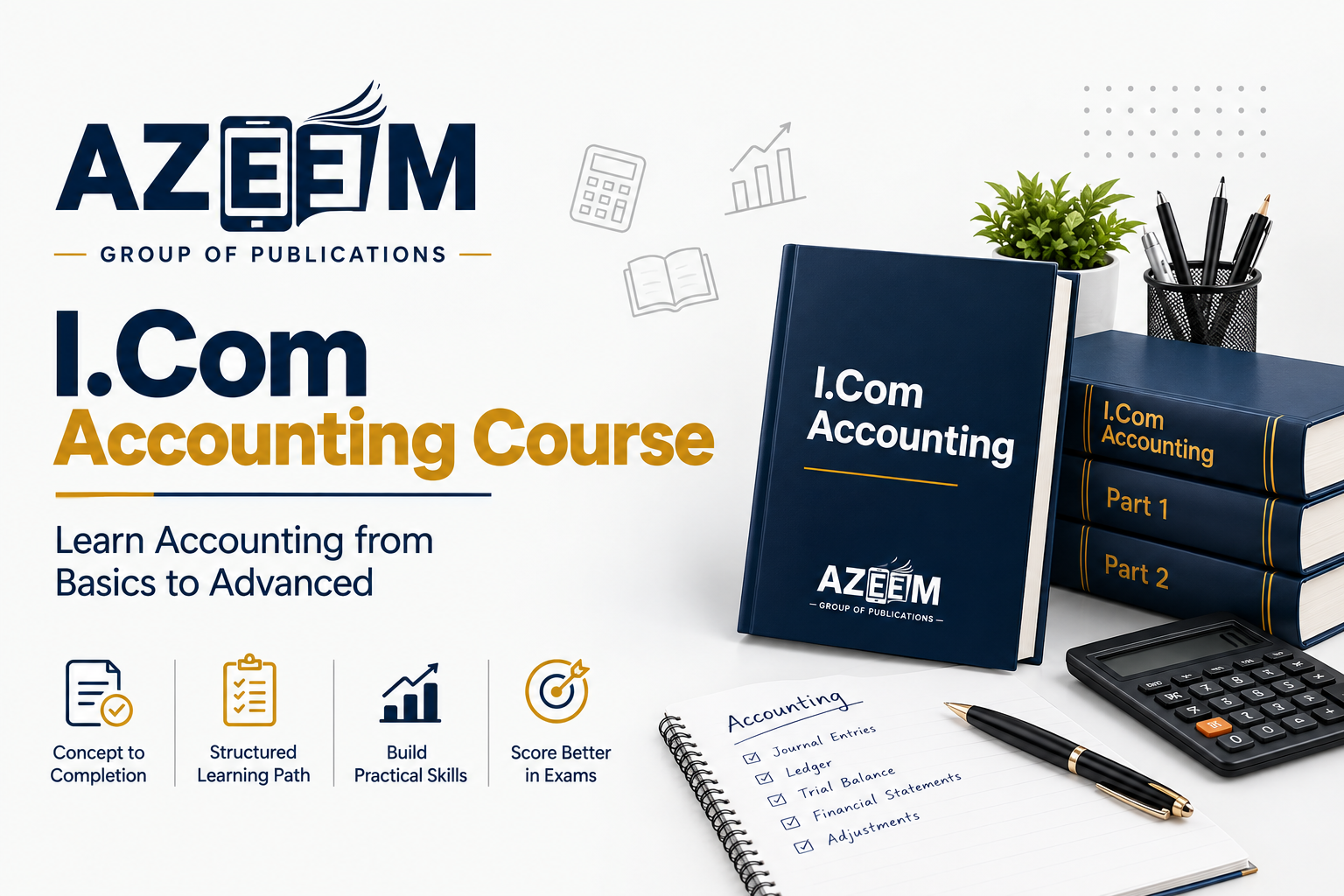
- I.Com Part 1 Accounting – Covers basic concepts, principles, and introductory topics.
- I.Com Part 2 Accounting – Builds on Part 1 with more advanced topics like partnership accounts, company accounts, and financial statement analysis.
This structured approach ensures that students gradually move from basic to advanced accounting concepts, making the subject easier to grasp over time.
Explore I.Com Accounting Part 1 and Part 2 for complete exam preparation.
Why I.Com Accounting is Important for Students
Understanding accounting at the intermediate level is not just about passing exams. It has long-term benefits that extend far beyond the classroom.
Building a Strong Financial Foundation
Accounting teaches students how businesses record, classify, and summarize financial transactions. This knowledge is essential for anyone planning to work in banking, finance, auditing, or business management in the future.
Gateway to Higher Studies
Many professional qualifications like ACCA, CA, ICMA, and CMA require a strong understanding of basic accounting principles. Students who master I.Com Accounting find it much easier to cope with the complexities of these advanced professional courses.
Practical Life Skills
Accounting isn’t just for accountants. Understanding financial statements, budgeting, and basic bookkeeping helps students manage personal finances and even run small businesses in the future.
Also read: I.Com Subjects Course: Complete Preparation for All Major Subjects
Core Topics Covered in I.Com Accounting
The I.Com Accounting syllabus is comprehensive and covers a wide range of topics that gradually increase in complexity. Here’s a breakdown of what students typically study:
I.Com Part 1: Basic Concepts
- Introduction to Accounting – Understanding what accounting is and its objectives
- Accounting Equation – The relationship between assets, liabilities, and owner’s equity
- Double Entry System – The foundation of modern bookkeeping
- Journal, Ledger, and Trial Balance – Recording and organizing financial transactions
- Bank Reconciliation Statement – Matching bank records with company records
- Rectification of Errors – Identifying and correcting accounting mistakes
- Depreciation – Understanding asset value reduction over time
I.Com Part 2: Advanced Concepts
- Partnership Accounts – Handling accounts for businesses with multiple owners
- Company Accounts – Understanding shares, dividends, and corporate financial statements
- Financial Statements Analysis – Interpreting balance sheets and income statements
- Single Entry System – Converting incomplete records into meaningful financial data
- Non-Profit Organization Accounts – Accounting for clubs, societies, and NGOs
- Cash Flow Statements – Tracking the movement of cash within a business
This progression from basic to advanced topics ensures that students develop both theoretical knowledge and practical skills.
Strengthen your accounting basics with Principles of Accounting Part 1.
How to Study I.Com Accounting Effectively
Accounting is a subject that requires consistent practice rather than rote memorization. Here are some proven strategies to excel in I.Com Accounting.
Understand the Concepts, Don’t Memorize
Accounting is built on logic and principles. Instead of memorizing solutions, focus on understanding why certain entries are made. Once you understand the logic behind double-entry bookkeeping, solving numerical problems becomes much easier.
Practice Numerical Problems Daily
Accounting is a practical subject, and the only way to master it is through regular practice. Solve as many numerical exercises as possible from your textbook and additional practice books.
Use Quality Reference Books
While the official textbook is essential, using supplementary accounting guides and workbooks can help clarify difficult concepts through additional examples, solved exercises, and simplified explanations.
Solve Past Papers
Past board examination papers give students a clear idea of the exam pattern, important topics, and question styles. Practicing these papers builds confidence and improves time management during exams.
Create Summary Notes
Accounting involves many formulas, formats, and procedures. Creating concise notes for journal entries, ledger formats, and financial statement structures helps in quick revision before exams.
Also read: I.Com Solved Past Papers.
Common Challenges Students Face in I.Com Accounting
Many students find accounting intimidating initially, but understanding common challenges can help address them early.
Difficulty with the Double Entry System
The concept of debit and credit confuses many beginners. The key is to practice multiple examples until the logic becomes second nature.
Weak Foundation in Part 1
Since Part 2 builds on Part 1 concepts, students who don’t fully grasp basic principles struggle later with partnership and company accounts. This is why building a strong foundation in the first year is crucial.
Time Management During Exams
Accounting papers often require solving lengthy numerical problems within limited time. Regular timed practice helps students improve speed and accuracy.
Prepare smarter for your I.Com Accounting exams with reliable study resources. Explore I.Com Accounting Books,
The Role of Good Academic Books in Learning Accounting
One of the most important factors in mastering I.Com Accounting is having access to well-structured, easy-to-understand academic books. A good accounting textbook should:
- Explain concepts in simple language with relevant examples
- Provide step-by-step solutions to numerical problems
- Include practice exercises with varying difficulty levels
- Cover the complete syllabus as prescribed by the board
- Offer solved past papers for exam preparation
Since accounting is a subject that heavily relies on practice, students benefit greatly from books that offer ample solved examples along with unsolved exercises for self-assessment.
Publishing houses that specialize in academic books play a vital role in supporting students’ learning journeys. Well-researched textbooks, aligned with the latest syllabus and board requirements, make a significant difference in how effectively students grasp accounting concepts.
Find the right resources for your studies. Explore I.Com Accounting Books.
Career Opportunities After I.Com Accounting
Completing I.Com with a strong grasp of accounting opens doors to numerous career paths and higher education opportunities.
Higher Education Options
- B.Com (Bachelor of Commerce)
- BBA (Bachelor of Business Administration)
- ACCA (Association of Chartered Certified Accountants)
- ICMA (Institute of Cost and Management Accountants)
- CA (Chartered Accountancy)
Career Fields
Students with a solid accounting background can pursue careers in:
- Banking and financial services
- Auditing firms
- Corporate finance departments
- Taxation and consultancy
- Business management and entrepreneurship
The skills learned in I.Com Accounting serve as the building blocks for these advanced qualifications and career paths.
Explore professional pathways in accounting through ACCA, CA (ICAP), ICMA Pakistan, and HEC Pakistan to plan your next step after I.Com.
Conclusion
The I.Com Accounting course is more than just a subject on your intermediate certificate—it’s the foundation for a successful future in commerce, finance, and business. From understanding basic bookkeeping principles to mastering advanced topics like company accounts and financial statement analysis, this course equips students with essential skills for both academic and professional growth.
Success in I.Com Accounting comes down to understanding core concepts, consistent practice, and using the right learning resources. Quality academic books that simplify complex topics and provide ample practice material can make the learning journey smoother and more effective.
Whether you’re preparing for board exams or planning to pursue further studies like ACCA or B.Com, mastering I.Com Accounting today will pay dividends throughout your academic and professional career. Invest time in understanding the fundamentals, practice regularly, and choose your study resources wisely your future in commerce starts here.
Also read: Where Can I Buy Books Online in Pakistan
FAQs
What is I.Com Accounting?
I.Com Accounting is a core subject in the Intermediate in Commerce program that teaches students the fundamentals of bookkeeping, financial transactions, accounting principles, and financial statements.
What topics are covered in I.Com Accounting?
Topics commonly include accounting principles, accounting equations, double-entry bookkeeping, journals, ledgers, trial balances, bank reconciliation, depreciation, partnership accounts, company accounts, and financial statements.
Is I.Com Accounting difficult for beginners?
It can seem difficult initially, especially when learning debit and credit rules. However, regular numerical practice and a clear understanding of basic accounting concepts can make the subject much easier.
How can I prepare for I.Com Accounting exams?
Students should understand concepts, practice numerical questions regularly, solve textbook exercises, review past papers, and create concise revision notes for important formats and procedures.
Which books are useful for I.Com Accounting?
Students should choose academic books that follow the relevant board syllabus and provide clear explanations, solved examples, practice exercises, and past-paper preparation material. Academic resources from publishers such as Azeem Groups can be considered alongside the prescribed textbook.
What can I study after I.Com?
Depending on eligibility and institutional requirements, I.Com graduates can consider programs and professional qualifications such as B.Com, BBA, ACCA, CA, and ICMA.
Why is Accounting important in I.Com?
Accounting develops an understanding of how financial transactions are recorded, classified, summarized, and interpreted. These fundamentals can support further study in commerce, finance, accounting, and business.
Browse our Shop, or Contact Us for more information.