Subjects Are in 1st Year Commerce is a common question for students choosing Commerce (I.Com) after matriculation, especially those planning a career in business, banking, accounting, or finance. Before stepping into college, students and parents naturally want to understand the subject structure clearly.
Understanding the subject structure of I.Com Part 1 helps students plan their study routine, choose the right books, and prepare a strong foundation for both board exams and future professional studies like B.Com, ACCA, CA, or CSS. In this article, we’ll break down the complete subject list, their scope, and tips to score well in each one.
Overview of 1st Year Commerce (I.Com Part 1)
I.Com Part 1, also known as 11th class Commerce, is a two-year intermediate program offered by boards of intermediate and secondary education (BISE) across Pakistan. It is designed for students who wish to pursue a career in the business and finance sector.
The curriculum blends theoretical knowledge with practical accounting and business skills, preparing students for higher studies and professional certifications later on.
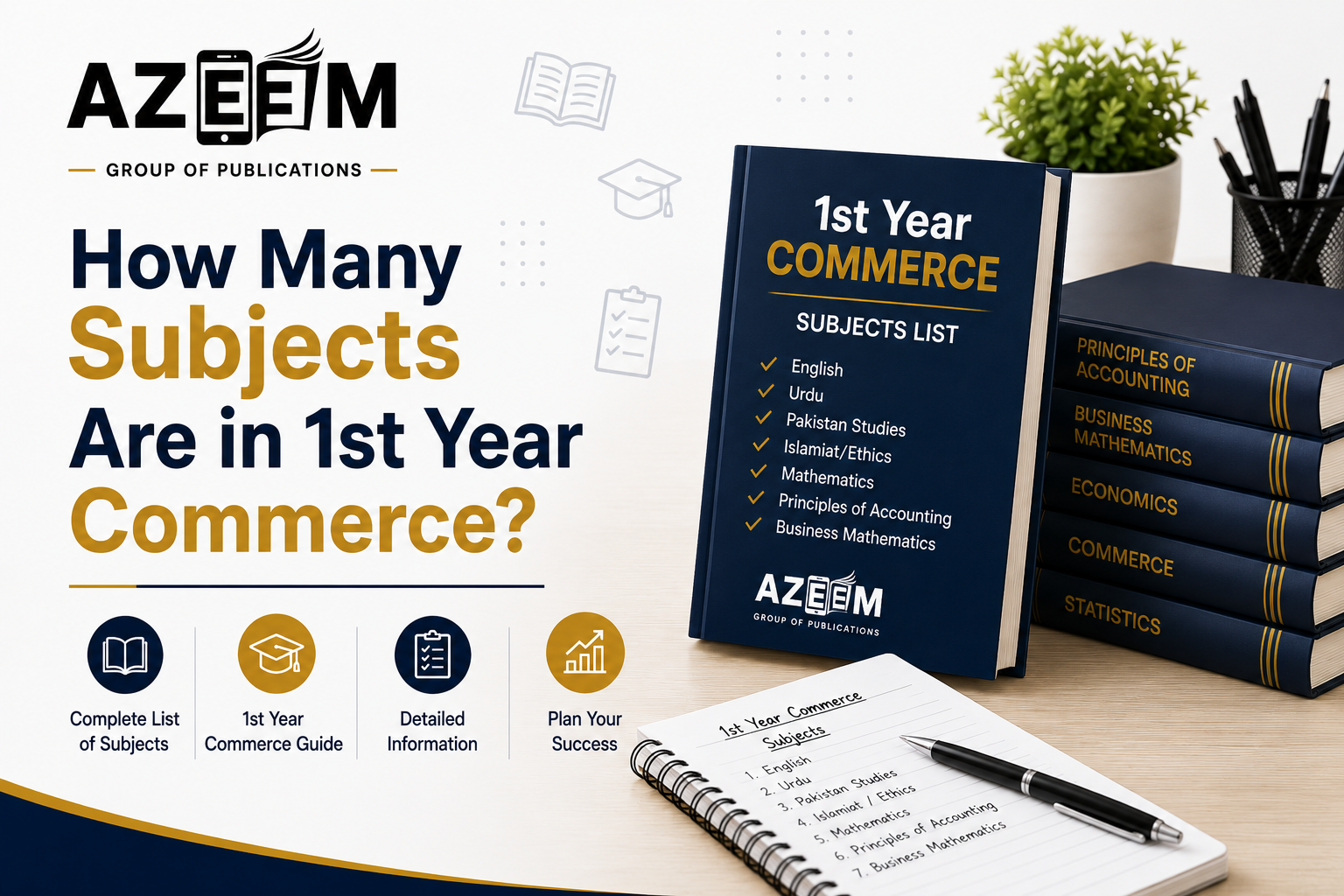
In most boards across Pakistan, 1st year commerce consists of six subjects, combining compulsory subjects and core commerce subjects. Let’s look at them in detail.
Also read: 1st Year ICOM Books Name: Complete List and Guide for Commerce Students
Complete List of Subjects in 1st Year Commerce
Here is the standard subject list followed by most Pakistani boards (with slight variations depending on the board):
1. English
English is a compulsory subject throughout intermediate education in Pakistan. It focuses on grammar, comprehension, translation, and essay writing skills, which are essential for both academic and professional communication.
2. Urdu (or Pakistan Studies, depending on board policy)
Urdu is generally a compulsory subject in Part 1, testing language and literature skills. Some boards have restructured their curriculum, moving Pakistan Studies to Part 1 and Urdu to Part 2, or vice versa. Students should check their respective board’s scheme of studies for confirmation.
3. Principles of Accounting
This is one of the most important subjects in I.Com. Principles of Accounting introduces students to the fundamentals of bookkeeping, journal entries, ledgers, trial balances, and financial statements. It builds the base for advanced accounting studies in Part 2 and beyond.
4. Principles of Economics
Economics helps students understand the fundamental concepts of demand, supply, production, consumption, and market structures. It is a theory-based subject that also has strong relevance in business decision-making.
5. Business Mathematics / Statistics
Depending on the board, this subject may be called Business Mathematics or Statistics. It covers essential quantitative techniques such as ratios, percentages, interest calculations, and elementary statistical tools used in business analysis.
6. Computer Science / Commercial Geography
Some boards include Computer Science, focusing on basic computer applications relevant to business, while others may offer Commercial Geography, which studies the geographical factors affecting trade, industry, and commerce.
Note: The exact subject names and order may vary slightly depending on the province and board (Punjab, Sindh, KPK, Balochistan, or Federal Board). It’s recommended to always check the official scheme of studies issued by your board.
Subject-Wise Breakdown Table
| Subject | Type | Focus Area |
| English | Compulsory | Language & Communication |
| Urdu / Pakistan Studies | Compulsory | Language / National Studies |
| Principles of Accounting | Core Commerce | Bookkeeping & Financial Statements |
| Principles of Economics | Core Commerce | Market & Economic Theory |
| Business Mathematics/Statistics | Core Commerce | Quantitative Business Skills |
| Computer Science/Commercial Geography | Elective/Core | Business Technology or Trade Geography |
Also read: What Are the Subjects of I.Com? A Complete Guide for Students in Pakistan
Why These Subjects Matter for Your Future
Each subject in I.Com Part 1 is designed to build a specific skill set that becomes crucial in higher education and professional life.
Building a Strong Accounting Foundation
Principles of Accounting is arguably the backbone of the entire commerce program. Students who master this subject early find it significantly easier to handle advanced accounting, auditing, and taxation subjects in B.Com, ACCA, or CA programs.
Developing Analytical and Economic Thinking
Economics trains students to think critically about markets, pricing, and resource allocation skills that are valuable not just for exams but for real-world business decisions.
Strengthening Quantitative Skills
Subjects like Business Mathematics or Statistics sharpen numerical and analytical abilities, which are essential for interpreting financial data, business reports, and market trends.
Preparing for a Digital Business World
With Computer Science included in many boards’ syllabi, students get early exposure to computer applications that are increasingly important in modern accounting software, spreadsheets, and digital business operations.
Also read: I.Com Solved Past Papers
Tips to Prepare for 1st Year Commerce Exams
- Choose the Right Books: Always study from board-approved and well-explained textbooks. A publisher offering updated, syllabus-aligned books with solved exercises and past paper guides can make a huge difference in exam preparation.
- Practice Accounting Regularly: Accounting is a practice-based subject solving daily journal entries and ledger problems builds accuracy and speed.
- Understand, Don’t Memorize Economics: Focus on grasping concepts like demand-supply curves and market structures rather than rote learning.
- Solve Past Papers: Past board papers help you understand the exam pattern, important recurring topics, and marking style.
- Keep a Revision Schedule: Divide your study time evenly across all six subjects instead of over-focusing on just one or two.
How to Choose the Right Study Material
With so many publishers offering I.Com textbooks and guides in Pakistan, students often get confused about which books to buy. Here’s what to look for:
- Board-aligned content that follows the latest syllabus and paper pattern.
- Solved exercises and numerical problems, especially for Accounting and Statistics.
- Simplified language for Economics and theory-based subjects.
- Past paper compilations with model answers for self-assessment.
- Updated editions that reflect any recent syllabus changes by your board.
A trusted academic publishing house can save students hours of confusion by offering complete subject-wise guides, notes, and key books tailored exactly to their board’s curriculum.
Also read: Is ICOM Better Than ICS? A Complete Comparison Guide for Pakistani Students
Conclusion
So, to directly answer the question 1st year commerce typically includes six subjects: English, Urdu or Pakistan Studies, Principles of Accounting, Principles of Economics, Business Mathematics or Statistics, and Computer Science or Commercial Geography. While the exact subject names may vary slightly by board, the overall structure remains fairly consistent across Pakistan.
Understanding this subject breakdown early on helps students plan their study strategy, invest in the right books, and build strong fundamentals for future studies in commerce, business, and finance. Whether you’re a student, parent, or teacher, having clarity on the I.Com Part 1 syllabus is the first step toward academic success.
If you’re looking for reliable, syllabus-aligned commerce textbooks and guides, choosing books from a trusted academic publisher ensures you get accurate content, clear explanations, and the best possible preparation for your board exams.
Check out to buy I.Com Books
FAQs
1. How many subjects are in 1st year Commerce?
The number of subjects in 1st year Commerce (I.Com Part 1) can vary depending on the education board and subject combination. Generally, students study six to seven subjects, including compulsory subjects and commerce-related subjects.
2. What are the main subjects in 1st year I.Com?
The main commerce subjects commonly include Principles of Accounting, Principles of Economics, Principles of Commerce, and Business Mathematics or Statistics. Students also study compulsory subjects according to their board’s scheme.
3. Is Accounting compulsory in 1st year Commerce?
Yes, Principles of Accounting is generally one of the core subjects in I.Com Part 1 and is an important part of the commerce curriculum.
4. Is Economics included in 1st year I.Com?
Yes. Principles of Economics is commonly included as a major commerce subject in 1st year I.Com.
5. Is Business Mathematics a subject in 1st year Commerce?
Yes, Business Mathematics is included in the I.Com Part 1 curriculum in many Pakistani boards. However, students should check their board’s latest subject scheme.
6. Which compulsory subjects are taught in 1st year I.Com?
Compulsory subjects can include English and Urdu, along with other subjects prescribed by the relevant board. The exact requirements may differ between boards.
7. Are 1st year Commerce subjects the same for every board in Pakistan?
Not necessarily. The subjects, combinations, syllabus and examination structure can differ between boards. Students should follow the latest scheme of studies issued by their respective board.
8. Is I.Com difficult for students?
I.Com can be manageable when students regularly practise subjects such as Accounting, Economics and Business Mathematics. Understanding concepts and solving questions consistently can make preparation easier.
9. Which subjects are important in I.Com Part 1?
Accounting, Economics, Commerce and Business Mathematics or Statistics are among the key subjects because they provide the foundation for further commerce studies.
10. Where can I find books for 1st year Commerce subjects?
Students can find I.Com Part 1 textbooks, subject guides and exam-preparation books through educational publishers and online bookshops such as Azeem Groups.
Explore I.Com Part 1 Books and choose subject-wise resources from our Shop. Need help? Contact Us.s