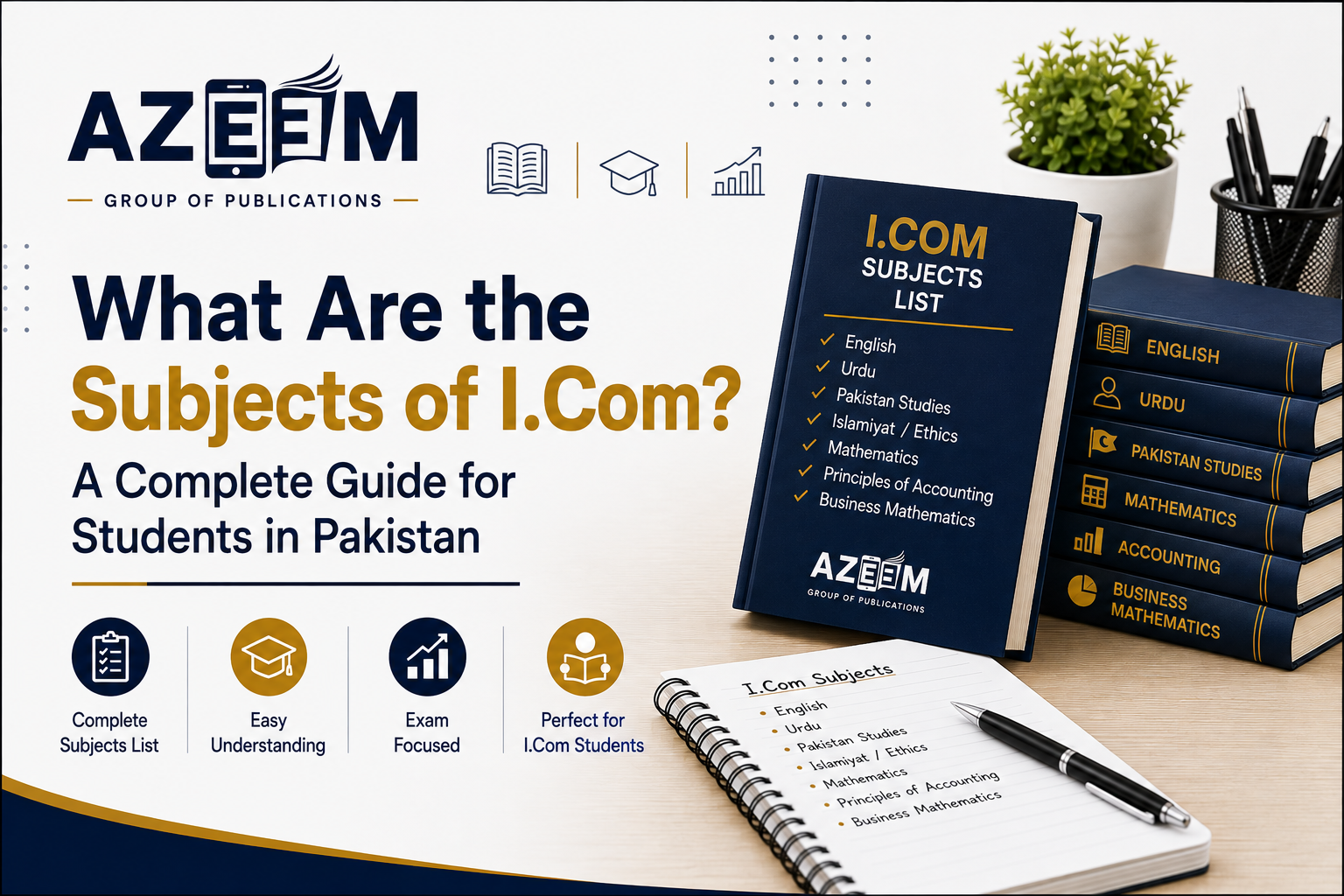
Choosing the right academic path after Matriculation is one of the biggest decisions a student makes in Pakistan. For those interested in business, finance, and trade, I.Com (Intermediate in Commerce) is one of the most popular options. But before enrolling, most students and parents ask the same question: what are the subjects of I.Com?
In this guide, we will break down the complete I.Com syllabus, covering both Part 1 and Part 2, along with tips on how to prepare effectively using the right academic books. Whether you’re a student, parent, or teacher, this article will give you a clear understanding of the I.Com subject structure.
What is I.Com?
I.Com, short for Intermediate in Commerce, is a two-year intermediate-level program offered by boards across Pakistan after completing Matriculation (Class 10). It is specifically designed for students who want to build a career in business, accounting, banking, or finance.
Unlike F.Sc or F.A, I.Com focuses heavily on commerce-related subjects such as accounting, economics, and business studies, making it an ideal choice for students aiming to pursue further studies like B.Com, BBA, ACCA, or CA.
The program is divided into two parts: I.Com Part 1 (11th grade) and I.Com Part 2 (12th grade), each with its own set of subjects.
I.Com Part 1 Subjects
In the first year of I.Com, students study a mix of compulsory and commerce-specific subjects. These form the foundation for advanced concepts taught in Part 2.
1. Principles of Accounting
This subject introduces students to the basics of bookkeeping and financial recording. Topics include journal entries, ledgers, trial balances, and preparing basic financial statements. It’s considered the backbone of the entire I.Com syllabus.
2. Principles of Economics
Economics teaches students how individuals, businesses, and governments make decisions about resources. Part 1 usually covers microeconomics concepts such as demand, supply, and market structures.
3. Business Mathematics
This subject applies mathematical techniques to real-world business problems, including profit and loss calculations, interest rates, ratios, and percentages.
4. Computer Studies
Given today’s digital economy, Computer Studies is included to build basic IT literacy, covering topics like computer fundamentals, MS Office applications, and an introduction to programming logic.
5. English
As a compulsory subject throughout intermediate education, English focuses on grammar, comprehension, and communication skills essential for professional life.
6. Urdu (or Pakistan Studies, depending on the board)
Some boards include Urdu as compulsory in Part 1, while others adjust this with Pakistan Studies across the two years.
7. Islamiyat
Islamiyat is a compulsory subject for Muslim students, covering Islamic teachings, history, and values.
I.Com Part 2 Subjects
The second year builds on the concepts introduced in Part 1, with more advanced and specialized commerce subjects.
1. Principles of Commerce
This subject expands on trade, commerce, and business organization concepts, including types of business entities, trade practices, and commercial documents.
2. Advanced Accounting / Principles of Accounting (Part 2)
Building on Part 1, this course dives deeper into partnership accounts, company accounts, and financial statement analysis.
3. Business Statistics
Statistics teaches students how to collect, analyze, and interpret business data, including measures of central tendency, dispersion, and probability.
4. Banking
This subject introduces students to the banking system in Pakistan, covering topics like types of banks, banking instruments, and the role of the State Bank of Pakistan.
5. Economics (Part 2)
The second year of Economics typically shifts focus to macroeconomic concepts, including national income, inflation, and Pakistan’s economic policies.
6. Pakistan Studies
This compulsory subject covers the history, geography, and constitutional development of Pakistan.
7. English (Part 2)
English continues into the second year with a focus on advanced writing, comprehension, and communication skills.
Compulsory vs Elective Subjects in I.Com
It’s important to understand that I.Com subjects are divided into two categories:
- Compulsory subjects: English, Urdu, Islamiyat, and Pakistan Studies — these are mandatory across almost all boards in Pakistan.
- Elective/Core commerce subjects: Accounting, Economics, Business Mathematics, Statistics, Banking, and Principles of Commerce.
While the compulsory subjects remain largely the same across boards, some variation exists depending on the province and examination board (such as BISE Lahore, BISE Karachi, or Federal Board). It’s always a good idea to check your specific board’s syllabus for exact subject combinations.
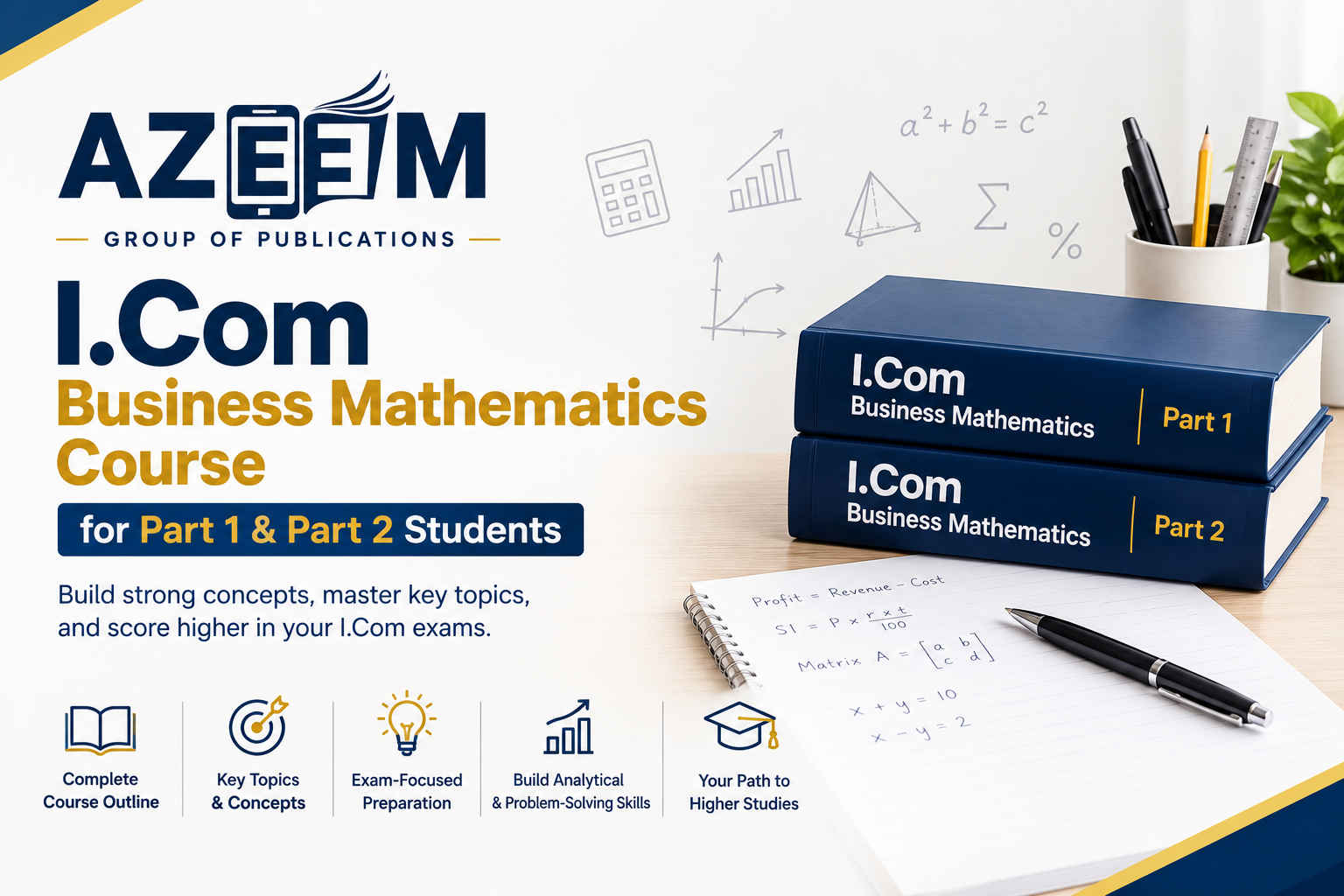
Also read: I.Com Business Mathematics Course for Part 1 & Part 2 Students
Why Choosing the Right Books Matters for I.Com Students
Since I.Com subjects like Accounting, Economics, and Statistics are concept-heavy and require consistent practice, having access to well-structured academic books makes a significant difference in exam preparation.
A good I.Com textbook should offer:
- Clear explanations of theoretical concepts
- Solved examples for accounting and statistics problems
- Practice exercises aligned with board exam patterns
- Past paper questions for exam preparation
- Updated content according to the latest syllabus
At our publishing house, we specialize in producing academic books tailored to the I.Com syllabus, designed by experienced educators to help students grasp difficult concepts with ease. Investing in the right books early in the academic year can save students from last-minute exam stress.
Career Opportunities After I.Com
Completing I.Com opens doors to a variety of career and academic paths, including:
- B.Com (Bachelor of Commerce)
- BBA (Bachelor of Business Administration)
- ACCA (Association of Chartered Certified Accountants)
- CA (Chartered Accountancy)
- Banking and Finance careers
- Government sector jobs related to accounts and finance
Because I.Com builds a strong foundation in accounting, economics, and business principles, students often find it easier to transition into professional finance and business degrees.
Tips to Score Well in I.Com
- Practice Accounting daily it’s a subject that improves with consistent problem-solving rather than just memorization.
- Understand Economics concepts rather than memorizing definitions; use real-life examples to relate to theories.
- Solve past papers for every subject to understand the exam pattern and important topics.
- Use quality reference books that simplify complex topics with examples and practice questions.
- Manage time effectively between compulsory and core subjects to avoid last-minute cramming.
Also read: Where Can I Buy Books Online in Pakistan
Conclusion
So, what are the subjects of I.Com? In summary, I.Com Part 1 and Part 2 together cover Accounting, Economics, Business Mathematics, Statistics, Banking, Principles of Commerce, Computer Studies, along with compulsory subjects like English, Urdu, Islamiyat, and Pakistan Studies.
This subject combination is specifically designed to prepare students for further studies and careers in business, finance, and accounting. Success in I.Com depends not just on understanding the syllabus, but also on using the right academic resources to build strong conceptual clarity.
If you’re an I.Com student looking for reliable, well-structured textbooks that align with your board’s syllabus, explore our collection of academic books designed to help you excel in every subject — from Accounting to Economics and beyond.
Check out to buy I.Com Books
FAQs
1. What are the subjects of I.Com in Pakistan?
I.Com subjects generally include Principles of Accounting, Principles of Economics, Principles of Commerce and Business Mathematics in Part I. Part II commonly includes Principles of Accounting, Commercial Geography, Principles of Banking and Business Statistics. Students also study compulsory subjects according to their board’s scheme.
2. What subjects are taught in I.Com Part 1?
The core I.Com Part 1 subjects commonly include Principles of Accounting, Principles of Economics, Principles of Commerce and Business Mathematics. For example, the Federal Board-affiliated Fazaia College lists these four subjects for Part I.
3. What subjects are taught in I.Com Part 2?
Common Part 2 subjects include Principles of Accounting, Commercial Geography, Principles of Banking and Business Statistics. The exact combination can vary depending on the board.
4. Is Accounting compulsory in I.Com?
Principles of Accounting is a core I.Com subject and is included in both Part I and Part II in several current I.Com schemes. It introduces students to bookkeeping, accounting concepts and financial records.
5. Is Economics a subject in I.Com?
Yes. Principles of Economics is commonly included in I.Com Part I. It introduces students to economic concepts and helps build a foundation for further studies in economics, business and finance.
6. Is Business Mathematics included in I.Com?
Yes. Business Mathematics is commonly offered as an I.Com Part I subject. It helps students develop numerical and analytical skills relevant to commerce and business.
7. Is Business Statistics taught in I.Com?
Yes. Business Statistics is commonly included in I.Com Part II. It covers the use of statistical methods for understanding and analysing business-related information.
8. What are the compulsory subjects in I.Com?
Compulsory subjects can include English, Urdu, Islamic Studies/Ethics and Pakistan Studies, although the timing and exact requirements can vary by board. For example, a Federal Board-affiliated college lists English, Urdu, Islamic Studies/Civics and Pakistan Studies as compulsory subjects.
9. Are I.Com subjects the same for every board in Pakistan?
Not necessarily. The core commerce subjects are broadly similar, but subject combinations, compulsory subjects, marks and paper structures can differ between boards. Students should check the latest scheme of studies for their specific board.
10. Which I.Com subjects are the most important for a commerce student?
Accounting, Economics, Commerce and Business Mathematics form an important foundation in Part I. These subjects help students develop knowledge and skills that can be useful for further studies in accounting, business, finance and commerce.
11. Is I.Com difficult for students?
I.Com can be manageable with consistent study and practice. Accounting and Mathematics require regular problem-solving, while Economics and Commerce require students to understand concepts and terminology.
12. What can I study after completing I.Com?
After I.Com, students can explore areas such as accounting, finance, business, banking, commerce and management. Depending on university eligibility requirements, possible pathways can include B.Com, BBA, accounting and finance degrees, and professional qualifications such as CA or ACCA.
Not sure which I.Com books match your subjects? Explore I.Com Part 1 & Part 2 Books or Contact Us for help choosing the right study material.